Global Anti-fatigue Mats Market Size, Share, Growth, Opportunities and Forecast 2034
Anti-fatigue Mats Market By Material (Rubber, Polyurethane, Organic, PVC, and Others), By Application (Commercial, Industrial, and Residential), By Distribution Channel (Offline and Online), and By Region - Global and Regional Industry Overview, Market Intelligence, Comprehensive Analysis, Historical Data, and Forecasts 2026 - 2034
| Market Size in 2025 | Market Forecast in 2034 | CAGR (in %) | Base Year |
|---|---|---|---|
| USD 1.99 Billion | USD 3.08 Billion | 5.01% | 2025 |
Anti-Fatigue Mats Industry Perspective:
What is the anticipated size of the anti-fatigue mats market during the projection period?
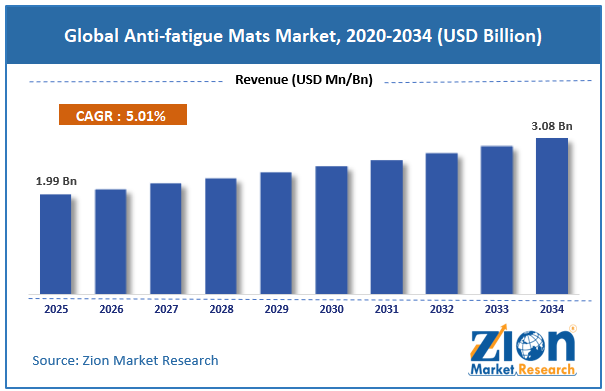
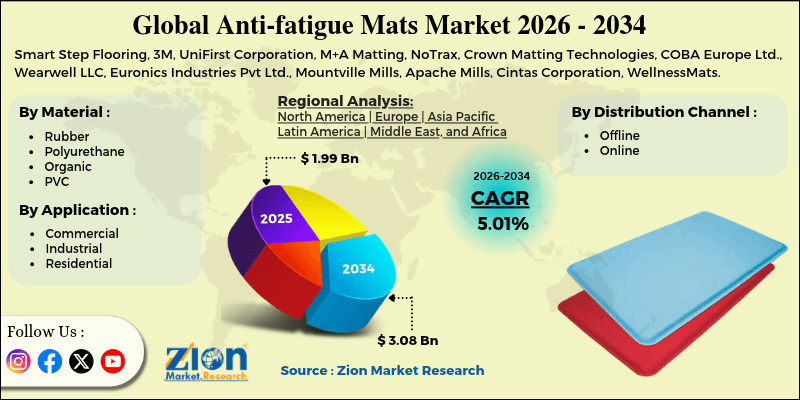
The global anti-fatigue mats market size was worth around USD 1.99 billion in 2025 and is predicted to grow to around USD 3.08 billion by 2034, with a compound annual growth rate (CAGR) of roughly 5.01% between 2026 and 2034.
Key Insights:
- As per the analysis shared by our research analyst, the global anti-fatigue mats market is estimated to grow annually at a CAGR of around 5.01% over the forecast period (2026-2034)
- In terms of revenue, the global anti-fatigue mats market size was valued at around USD 1.99 billion in 2025 and is projected to reach USD 3.08 billion, by 2034.
- The anti-fatigue mats market is projected to grow at a significant rate due to rising musculoskeletal diseases worldwide, increasing focus on workplace safety, and enhanced public awareness.
- Based on the material, the rubber segment is growing at a high rate and will continue to dominate the global market as per industry projections.
- Based on the application, the industrial segment is anticipated to command the largest market share.
- Based on the distribution channel, the online segment is anticipated to generate the highest CAGR of 6.3% in the coming years.
- Based on region, Asia-Pacific is projected to dominate the global market during the forecast period.
Anti-Fatigue Mats Market: Overview
Anti-fatigue mats reduce physical strain for people who stand for long hours on hard surfaces such as tile and concrete floors in residential, commercial, or industrial settings. Anti-fatigue mats consist of cushioned, supportive surfaces. They encourage subtle movement in leg muscles and feet. They also differ from conventional mats by reducing muscle tension, improving circulation, and minimizing joint pressure. During the forecast period, demand for anti-fatigue mats is expected to grow due to rising musculoskeletal diseases worldwide, increasing focus on workplace safety, and enhanced public awareness. However, the high cost of anti-fatigue mats, competition from other alternatives, and a limited number of players may impact market revenue in the long run.
Impact of the USA-Israel and Iran war on the Anti-Fatigue Mats Market:
The USA-Israel and Iran war has indirectly affected the anti-fatigue mats market. The ongoing conflict has no direct correlation with anti-fatigue mat production and distribution. However, the war has created economic uncertainty worldwide, increased the cost of living, and driven up consumer goods prices. Additionally, shipment delays and changes in trade partnerships are other unwanted impacts of the war.
Anti-Fatigue Mats Market: Dynamics
Growth Drivers
How will increased cases of musculoskeletal disorders influence growth in the anti-fatigue mats market?
The global anti-fatigue mats market is expected to be driven by rising cases of musculoskeletal disorders, especially in intensive work environments. According to the Health and Safety Executive (HSE), work-related musculoskeletal disorders contributed around 7.3 million lost working days in 2021 and 2022. Market research suggests that over 85.9% of anti-fatigue mat users report improved comfort and reduced pain after frequent use. The growing number of patients with common musculoskeletal disorders such as neck pain, lower back pain, osteoarthritis, and work-related repetitive strain injuries will subsequently propel demand for anti-fatigue mats in the coming years.
Growing emphasis on workplace safety to prove beneficial for anti-fatigue mats manufacturers
Workplace safety has become a key topic of discussion among regulatory authorities, employers, and workers. Industries with prolonged standing and repetitive tasks are under scrutiny to provide enhanced, comfortable work environments for employees. Additionally, growing awareness about occupational health risks is encouraging rapid adoption of ergonomic workplace solutions. Additionally, the global anti-fatigue mats market players are offering enhanced, customizable, and high-performance mats for commercial and industrial applications.
Restraints
High cost and limited awareness to affect growth in the anti-fatigue mats industry
The global anti-fatigue mats industry is anticipated to be restricted by the high cost and limited awareness worldwide. Anti-fatigue mats are specially designed tools offering unique solutions. They cost more to develop and procure than traditional mats. Additionally, public awareness of the benefits of anti-fatigue mats in remote parts of the world is relatively low, limiting overall industry adoption trends.
Opportunities
Why will production innovation play a crucial role in promoting growth in the anti-fatigue mats market?
The global anti-fatigue mats market can benefit from investing in consistent product innovation. This includes using advanced materials and production technologies to deliver high-performance solutions. For instance, advanced foam, rubber, or polyvinyl chloride (PVC) materials can enhance the shock absorption capabilities of the mats. They can also facilitate fire resistance and improved drainage. Furthermore, eco-friendly anti-fatigue mats made using organic or recyclable materials can attract new consumer groups, especially buyers seeking sustainable products.
Growing adoption across commercial kitchen and healthcare facilities to open new growth avenues for anti-fatigue mats market companies
Commercial kitchens and healthcare facilities are emerging as major contributors to the growing demand for anti-fatigue mats. The rapid expansion of food service facilities and the modernization of healthcare settings, where employees must stand for prolonged periods, will benefit market leaders in the long run.
Challenges
What are the leading challenges in the anti-fatigue mats industry?
The global anti-fatigue mats industry will face challenges from competition from conventional mats and other ways to reduce physical strain. Moreover, a limited number of players, fluctuations in raw material prices, growing economic uncertainty, and maintenance requirements may create additional barriers to industry growth.
Anti-fatigue Mats Market: Report Scope
| Report Attributes | Report Details |
|---|---|
| Report Name | Anti-fatigue Mats Market |
| Market Size in 2025 | USD 1.99 Billion |
| Market Forecast in 2034 | USD 3.08 Billion |
| Growth Rate | CAGR of 5.01% |
| Number of Pages | 227 |
| Key Companies Covered | Smart Step Flooring, 3M, UniFirst Corporation, M+A Matting, NoTrax, Crown Matting Technologies, COBA Europe Ltd., Wearwell LLC, Euronics Industries Pvt Ltd., Mountville Mills, Apache Mills, Cintas Corporation, WellnessMats, Durable Corporation, Ergomat AS, and others. |
| Segments Covered | By Material, By Application, By Distribution Channel, and By Region |
| Regions Covered | North America, Europe, Asia Pacific (APAC), Latin America, Middle East, and Africa (MEA) |
| Base Year | 2025 |
| Historical Year | 2020 - 2024 |
| Forecast Year | 2026 - 2034 |
| Customization Scope | Avail customized purchase options to meet your exact research needs. Request For Customization |
Anti-Fatigue Mats Market: Segmentation
The global anti-fatigue mats market is segmented based on material, application, distribution channel, and region.
Why will the polyurethane segment lead the anti-fatigue mats industry revenue during the forecast period?
Based on material, the global market segments are rubber, polyurethane, organic, PVC, and others. In 2025, the rubber segment showed the highest growth. It accounted for 42% of the total market share. During the forecast period, it will continue leading the market due to the superior performance of rubber-based mats. Their widespread applications across commercial kitchens, industrial facilities, and retail structures will drive segmental growth in the future.
Which application will grow the fastest during the forecast period in the anti-fatigue mats market?
Based on application, the global anti-fatigue mats industry is divided into commercial, industrial, and residential. In 2025, the industrial segment generated the highest revenue, accounting for 58.9% of total market revenue. It is expected to lead the market with a 7.21% CAGR in the coming years. Emphasis on workplace safety, stricter laws for industrial complexes, and rapid industrialization will aid segmental prominence.
Which factors drive demand in the online segment in the anti-fatigue mats industry?
Based on distribution channel, the global market segments are offline and online. In 2025, the offline segment held the highest market share, contributing 68.92% of the final market share. The online segment is anticipated to generate the highest CAGR of 6.3% in the coming years. Easy buying, emergence of the quick commerce segment, excellent return policies, and access to new-generation consumer electronics with internet will aid segmental growth during the forecast period.
Anti-Fatigue Mats Market: Regional Analysis
Why will Asia-Pacific lead the anti-fatigue mats market in the coming years?
The global anti-fatigue mats market is currently led by Asia-Pacific. In 2025, it accounted for 33.35% of the global revenue and will grow at a strong CAGR during the forecast period. Asia-Pacific is a leading producer of mass-produced consumer goods, with China and India driving regional growth. Moreover, the proliferation of industrial facilities, manufacturing complexes, and a vast retail landscape will drive regional revenue in the coming years.
How is Europe expected to perform in the anti-fatigue mats market during the forecast period?
Europe is expected to emerge as a strong player in the anti-fatigue mats market with a significant CAGR of 6.9% during the forecast period. In 2025, it accounted for 30% of the market revenue. Growth in Europe will be led by strict workplace safety laws and implementation policies. Companies and industries operating in the European markets must offer an ergonomic work environment. Failure to comply can result in significant monetary and non-monetary losses. Moreover, greater employee awareness and rising demand for eco-friendly solutions will support product innovation across Europe.
Anti-Fatigue Mats Market: Competitive Analysis
The global anti-fatigue mats market is led by players like:
- Smart Step Flooring
- 3M
- UniFirst Corporation
- M+A Matting
- NoTrax
- Crown Matting Technologies
- COBA Europe Ltd.
- Wearwell LLC
- Euronics Industries Pvt Ltd.
- Mountville Mills
- Apache Mills
- Cintas Corporation
- WellnessMats
- Durable Corporation
- Ergomat AS
What are the latest key trends in the anti-fatigue mats market?
Mat customization
Growing demand for personalized anti-fatigue mats is a prominent market trend. This includes tailoring mats by surface texture, thickness, shape, and size to meet end-user needs.
Demand for mats with easy maintenance
Hygienic, easy-maintenance mats with antimicrobial surfaces and chemical resistance have become increasingly popular in healthcare and food service. Companies can leverage this trend by offering solutions that comply with the requirements of hygiene-sensitive environments.
The global anti-fatigue mats market is segmented as follows:
By Material
- Rubber
- Polyurethane
- Organic
- PVC
- Others
By Application
- Commercial
- Industrial
- Residential
By Distribution Channel
- Offline
- Online
By Region
- North America
- The U.S.
- Canada
- Mexico
- Europe
- France
- The UK
- Spain
- Germany
- Italy
- Rest of Europe
- Asia Pacific
- China
- Japan
- India
- Australia
- South Korea
- Rest of Asia Pacific
- The Middle East & Africa
- Saudi Arabia
- UAE
- Egypt
- Kuwait
- South Africa
- Rest of the Middle East & Africa
- Latin America
- Brazil
- Argentina
- Rest of Latin America
Table Of Content
Methodology
FrequentlyAsked Questions
Anti-fatigue mats are designed to reduce physical strain on people who stand for long hours on hard surfaces such as tile and concrete floors across residential, commercial, or industrial landscapes.
The global anti-fatigue mats market is expected to be driven by rising cases of musculoskeletal disorders, especially in intensive work environments.
According to study, the global anti-fatigue mats market size was worth around USD 1.99 billion in 2025 and is predicted to grow to around USD 3.08 billion by 2034.
The CAGR value of the anti-fatigue mats market is expected to be around 5.01% during 2026-2034.
The global anti-fatigue mats industry will be challenged by competition from conventional mats and other forms of reducing physical strain.
Mat customization and demand for mats with easy maintenance are the emerging trends and innovations impacting the anti-fatigue mats market.
The global anti-fatigue mats market has performed well so far and will offer similar trends in the coming years.
Asia-Pacific will contribute notably towards the anti-fatigue mats market value.
The global anti-fatigue mats market is led by players like Smart Step Flooring, 3M, UniFirst Corporation, M+A Matting, NoTrax, Crown Matting Technologies, COBA Europe Ltd., Wearwell LLC, Euronics Industries Pvt Ltd., Mountville Mills, Apache Mills, Cintas Corporation, WellnessMats, Durable Corporation, and Ergomat AS.
The report explores crucial aspects of the anti-fatigue mats market, including a detailed discussion of existing growth factors and restraints, while also browsing future growth opportunities and challenges that impact the market.

List of Contents
Anti-Fatigue MatsIndustry Perspective:Key Insights:Anti-Fatigue Mats OverviewAnti-Fatigue Mats DynamicsReport ScopeAnti-Fatigue Mats SegmentationAnti-Fatigue Mats Regional AnalysisAnti-Fatigue Mats Competitive AnalysisWhat are the latest key trends in the anti-fatigue mats market?The global anti-fatigue mats market is segmented as follows:HappyClients